• it VO
  • fr Français
  • en English
  • ar العربية
About us
  • In-depth
    • All
    • Features
    • Files
    • World
    Morocco: 600 abortions a day—Alarming figures and tragic stories

    Morocco: 600 abortions a day—Alarming figures and tragic stories

    In Spain, the right to abortion is not guaranteed for all

    In Spain, the right to abortion is not guaranteed for all

    Invisible and vulnerable: Migrant women at the frontlines of Spain’s prostitution debate

    Invisible and vulnerable: Migrant women at the frontlines of Spain’s prostitution debate

    Serbia: Is contraception a luxury or a basic human right?

    Serbia: Is contraception a luxury or a basic human right?

    Rebels, witnesses, victims: Women against the mafia (3/3)

    Rebels, witnesses, victims: Women against the mafia (3/3)

    Trending Tags

    • Women artists
    • Ecofeminism
    • Women living from and on the streets
    • Women and bodies
    • Women and sports
    • Women and cinema
    • Ramadan series
    • Women and war
    • Women Living at the Margins
    • Press Freedom from the Perspective of Women Journalists
    • Period poverty
    • Gynecological violence
    • Women and prison
    • Safe spaces
    • Abortion and SRHR
    • Transgenderism
    • Women in rural areas
  • On the move
    Spain: CEAR and the fight against human trafficking

    Spain: CEAR and the fight against human trafficking

    Gaza: How many journalists must be killed for the world to react?

    Gaza: How many journalists must be killed for the world to react?

    Moroccan activist Ibtissam Lachgar held in solitary confinement, health in crisis

    Moroccan activist Ibtissam Lachgar held in solitary confinement, health in crisis

    Three women for one man’s pay: The plight of female agricultural workers in Egypt

    Three women for one man’s pay: The plight of female agricultural workers in Egypt

  • Portraits
    Sophie Bessis: “The battle for the intimate will be long, especially in the Global South!”

    Sophie Bessis: “The battle for the intimate will be long, especially in the Global South!”

    “Mom, Dad, Can We Talk About Privacy?”—A Tunisian children’s book on protecting kids from sexual violence

    “Mom, Dad, Can We Talk About Privacy?”—A Tunisian children’s book on protecting kids from sexual violence

    Kurdish journalist killed in Turkish drone strike in northeastern Syria

    Kurdish journalist killed in Turkish drone strike in northeastern Syria

    A Filmmaker’s Journey: Inside the Creative World of Margarita Bareikyte

    A Filmmaker’s Journey: Inside the Creative World of Margarita Bareikyte

  • Creations
    • All
    • Reviews
    • Visual Arts
    “La Malédiction (1)”, a theatrical adaptation of King Kong Theory bursting with Tunisian rage

    “La Malédiction (1)”, a theatrical adaptation of King Kong Theory bursting with Tunisian rage

    “Mom, Dad, Can We Talk About Privacy?”—A Tunisian children’s book on protecting kids from sexual violence

    “Mom, Dad, Can We Talk About Privacy?”—A Tunisian children’s book on protecting kids from sexual violence

    The El’Sardines series, a delicate feminist manifesto centered around an ecological mystery

    The El’Sardines series, a delicate feminist manifesto centered around an ecological mystery

    Atlantics, a film by Mati Diop: Filming the embodied resistance of spirits

    Atlantics, a film by Mati Diop: Filming the embodied resistance of spirits

  • Opinion
    Women in Gaza are living their worst nightmares - “ I want to go back to my life before the war, to my privacy, my home ”

    Women in Gaza are living their worst nightmares - “ I want to go back to my life before the war, to my privacy, my home ”

    Messages from life under bombardment—Can a mother cope with losing her six children at once? (10)

    Messages from life under bombardment—Can a mother cope with losing her six children at once? (10)

    Messages from life under bombardment—No cake for my children on their birthdays (9)

    Messages from life under bombardment—No cake for my children on their birthdays (9)

    Messages from life under bombardment – No food or water in Gaza (8)

    Messages from life under bombardment – No food or water in Gaza (8)

  • Multimedia
    "I hope it doesn’t go viral: Journalism and sexist attacks in digital age". A video investigation by Çiçek Tahaoğlu

    "I hope it doesn’t go viral: Journalism and sexist attacks in digital age". A video investigation by Çiçek Tahaoğlu

    Period poverty in Montenegro

    Period poverty in Montenegro

    Period poverty in France (1)

    Period poverty in France (1)

    Period Poverty in Italy

    Period Poverty in Italy

  • Country context
No Result
View All Result
BLOGS
Medfeminiswiya
  • In-depth
    • All
    • Features
    • Files
    • World
    Morocco: 600 abortions a day—Alarming figures and tragic stories

    Morocco: 600 abortions a day—Alarming figures and tragic stories

    In Spain, the right to abortion is not guaranteed for all

    In Spain, the right to abortion is not guaranteed for all

    Invisible and vulnerable: Migrant women at the frontlines of Spain’s prostitution debate

    Invisible and vulnerable: Migrant women at the frontlines of Spain’s prostitution debate

    Serbia: Is contraception a luxury or a basic human right?

    Serbia: Is contraception a luxury or a basic human right?

    Rebels, witnesses, victims: Women against the mafia (3/3)

    Rebels, witnesses, victims: Women against the mafia (3/3)

    Trending Tags

    • Women artists
    • Ecofeminism
    • Women living from and on the streets
    • Women and bodies
    • Women and sports
    • Women and cinema
    • Ramadan series
    • Women and war
    • Women Living at the Margins
    • Press Freedom from the Perspective of Women Journalists
    • Period poverty
    • Gynecological violence
    • Women and prison
    • Safe spaces
    • Abortion and SRHR
    • Transgenderism
    • Women in rural areas
  • On the move
    Spain: CEAR and the fight against human trafficking

    Spain: CEAR and the fight against human trafficking

    Gaza: How many journalists must be killed for the world to react?

    Gaza: How many journalists must be killed for the world to react?

    Moroccan activist Ibtissam Lachgar held in solitary confinement, health in crisis

    Moroccan activist Ibtissam Lachgar held in solitary confinement, health in crisis

    Three women for one man’s pay: The plight of female agricultural workers in Egypt

    Three women for one man’s pay: The plight of female agricultural workers in Egypt

  • Portraits
    Sophie Bessis: “The battle for the intimate will be long, especially in the Global South!”

    Sophie Bessis: “The battle for the intimate will be long, especially in the Global South!”

    “Mom, Dad, Can We Talk About Privacy?”—A Tunisian children’s book on protecting kids from sexual violence

    “Mom, Dad, Can We Talk About Privacy?”—A Tunisian children’s book on protecting kids from sexual violence

    Kurdish journalist killed in Turkish drone strike in northeastern Syria

    Kurdish journalist killed in Turkish drone strike in northeastern Syria

    A Filmmaker’s Journey: Inside the Creative World of Margarita Bareikyte

    A Filmmaker’s Journey: Inside the Creative World of Margarita Bareikyte

  • Creations
    • All
    • Reviews
    • Visual Arts
    “La Malédiction (1)”, a theatrical adaptation of King Kong Theory bursting with Tunisian rage

    “La Malédiction (1)”, a theatrical adaptation of King Kong Theory bursting with Tunisian rage

    “Mom, Dad, Can We Talk About Privacy?”—A Tunisian children’s book on protecting kids from sexual violence

    “Mom, Dad, Can We Talk About Privacy?”—A Tunisian children’s book on protecting kids from sexual violence

    The El’Sardines series, a delicate feminist manifesto centered around an ecological mystery

    The El’Sardines series, a delicate feminist manifesto centered around an ecological mystery

    Atlantics, a film by Mati Diop: Filming the embodied resistance of spirits

    Atlantics, a film by Mati Diop: Filming the embodied resistance of spirits

  • Opinion
    Women in Gaza are living their worst nightmares - “ I want to go back to my life before the war, to my privacy, my home ”

    Women in Gaza are living their worst nightmares - “ I want to go back to my life before the war, to my privacy, my home ”

    Messages from life under bombardment—Can a mother cope with losing her six children at once? (10)

    Messages from life under bombardment—Can a mother cope with losing her six children at once? (10)

    Messages from life under bombardment—No cake for my children on their birthdays (9)

    Messages from life under bombardment—No cake for my children on their birthdays (9)

    Messages from life under bombardment – No food or water in Gaza (8)

    Messages from life under bombardment – No food or water in Gaza (8)

  • Multimedia
    "I hope it doesn’t go viral: Journalism and sexist attacks in digital age". A video investigation by Çiçek Tahaoğlu

    "I hope it doesn’t go viral: Journalism and sexist attacks in digital age". A video investigation by Çiçek Tahaoğlu

    Period poverty in Montenegro

    Period poverty in Montenegro

    Period poverty in France (1)

    Period poverty in France (1)

    Period Poverty in Italy

    Period Poverty in Italy

  • Country context
About us
Medfeminiswiya
About us

The saleswomen of the Cairo metro: chased and harassed in times of economic collapse

Peddling saleswomen in the Cairo metro system are classified as informal workers, operating without an official work contract or social insurance. This category of workers has been ignored for years. But the stories of these saleswomen are harsh, and they can be read on their faces, on the constant fear and anxiety legible in their features.

Shaimaa El Youssef by Shaimaa El Youssef
13 October 2024
in Files, In-depth
101 6
0
Share on FacebookShare on Twitter

This post is also available in: Français (French) العربية (Arabic)

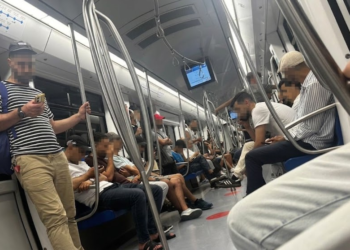
Amid the throngs of jostling bodies deep in the dark Cairo metro, passengers compete for a seat and peddling saleswomen hide from security guards. When the trains start moving, these women also start to advertise their wares, reassured that the metro police are nowhere in sight. The saleswomen display their products, priced to appeal to residents of the popular areas located along the routes of the first and second metro lines.

What is these women’s story?

There is constant fear and anxiety legible on the faces of the Cairo metro saleswomen. None of them will engage in any conversation with you unless it’s about buying or selling, for fear of undercover policemen, or harassers, or thieves. Yet despite this they’ve still managed to devise attractive advertising methods to sell their products, with low prices to beat the competition: 3-for-1 deals, “glistening and smooth skin for 15 pounds,” “kohl liners for wholesale prices and a free lipstick.”

Noura Abdel Fattah, 28 years old, stands in one of the carriages, a miserable expression on her face. She is selling tissues for less than half their price in stores—three packs for 10 Egyptian pounds, the equivalent of 21 US cents, as opposed to one pack sold in stores for five Egyptian pounds. You’ll spot her with her infant daughter fastened to her chest, held secure with a piece of cloth around the waist to stop her from potentially falling while Noura is running between carriages or trying to hide from police. Policemen lurk in the metro looking for these saleswomen to file reports against them, as selling in the metro is against Egyptian law. Street vendors are not allowed to pursue people, display their goods, or practice their craft inside passenger transport vehicles such as buses, trams, trains, and metro stations. Violators of this law are subject to imprisonment and a fine of up to 250 Egyptian pounds, the equivalent of 5 US dollars (1).

Before getting divorced, Noura’s husband used to severely beat her. After getting out of this failed marriage, she urgently needed to work so she could feed herself and her daughter. This prompted her to work as a saleswoman inside metro cars. “My husband threw my daughter and me out. My neighbor advised me to sell tissues on the metro so I could support my daughter.”

Three million female-headed households in Egypt

Noura earns 100 to 150 Egyptian pounds—2 to 3.11 US dollars—for a full day’s work, which means her monthly income ranges between 50 and 70 US dollars. This is nowhere near enough to live on given the high prices and economic collapse. “As soon as I see a security guard,” she says, “I hide among the passengers. If I’m caught, I’ll be fined, and they could take every cent I have—I won’t have any money left to buy food.” 

In a country suffering from high unemployment rates that reached 7.2% in 2022, with a total of 8 million unemployed people according to the Central Agency for Public Mobilization and Statistics (CAPMAS) (2), Egyptian women are also affected. In 2020, 3.3 million families—out of 24.7 million—were supported by women (3).

In this context, Nahla al-Dabaa, Chairwoman of the Board of Directors of the Sabya Association for Women and Children, believes that Egyptian women need to be economically empowered to achieve financial independence and therefore become less exposed to various forms of violence. “It’s difficult for divorced women to get job opportunities, be it in the public or the private sector,” she says. “Some of them resort to manual work for which there are no markets, making it hard for them to have a decent life.”

Egyptian women need to be economically empowered to achieve financial independence and become less exposed to various forms of violence.

Their markets: Metro Lines 1 and 2

In another carriage is Umm Muhammad, 56, who makes her way through the women’s carriages on the metro’s Lines 1 and 2. Peddlers, both male and female, are spread throughout these lines, carrying various goods such as biscuits, head coverings, lighters, kitchen tape, keychains, women’s underwear, cloths for cleaning glass, candy, makeup, pens, children’s coloring books… and these goods are sold at low prices not exceeding 0.5 US cents.

It's on these two lines that the metro saleswomen find a market for what they’re selling: they target working women from popular neighborhoods such as al-Matareya, Ain Shams, al-Khosous, Dar al-Salam, and al-Marg, who take the metro to and from work and choose to buy products there, from metro saleswomen, rather than having to go to the market to buy the same products at higher prices. On the metro’s Line 3, however, a lot less sales are occurring. This is due to intensifying security campaigns on that line and the ensuing arrest of the saleswomen who do not manage to escape and are then fined. Not to mention that this line passes through higher-income areas whose residents would not rather buy poor-quality goods such as those displayed in metro cars. These higher-income neighborhoods include Mohandiseen, Zamalek, Dokki, and Downtown, for example. Many foreigners—both residents and tourists—can be found in these areas, hence the metro administration’s keenness to maintain a “civilized” appearance of the metro. Egyptian MP Enas Abdel Halim even called on parliament to do away with this phenomenon (4).

“There are designated places for buying and selling in the metro, outside the cars, organized by official and legal permits. What is happening inside the metro cars is a threat to passengers’ comfort. These saleswomen put themselves at risk for very poor wages. They must look for real job opportunities,” according to MP Abdel Halim.

Endless difficulties

Let’s go back to Umm Muhammad. She has been selling clothes in the metro for five years. She used to carry a heavy bag in which she hid her goods from the police, so they wouldn’t confiscate them then file a report against her and force her to pay a fine.

Over time, due to joint pain and osteoporosis, Umm Muhammad was no longer able to carry this bag. Once, while she was trying to catch the metro, she fell, and her goods fell with her. She suffered a cruciate ligament tear. Another vendor in the metro then advised her to sell sweets: they are light and easy to carry. “It’s hard for me to walk between the metro cars,” Umm Muhammad says, “but if I don’t go there and sell things, I won’t be able to pay rent, and my landlord will evict me.”

After her husband’s death, Umm Muhammad no longer had any income, and the widow’s pension paid by the Ministry of Social Solidarity, which amounts to about 436 Egyptian pounds—the equivalent of 9.09 USD—per month, was not enough to survive on. She had no way to pay the rent she was already late on and had to look for something that would save her from eviction. It is worth noting that the average cost of living in Egypt is USD 250 per month per person. “Yes, working in the metro is tiring, but it’s better than dying alone between four walls,” Umm Muhammad divulges.

“Every day, I am harassed. There are those who put their hands on my body and those who harass me verbally, but what can I do? Poverty is humiliation.”

It's not just the physical effort of working in the metro that’s difficult for these saleswomen but also the harassment they are exposed to. Maryam Saad, 32, complains about the verbal and physical harassment she is exposed to daily while working in the metro cars. But the lack of job opportunities, high price of basic commodities, high cost of living, and the need to provide for her family left her no choice but to sell women’s clothing in the metro. “Every day, I am harassed. There are those who put their hands on my body and those who harass me verbally, but what can I do? Poverty is humiliation,” Maryam says.

A study issued by the United Nations Entity for Gender Equality and the Empowerment of Women shows that more than 90% of Egyptian women have been subjected to some form of sexual harassment (5).

The economic crisis makes life harder

Maryam’s economic situation deteriorated over the course of the past few years due to the economic crisis in Egypt and the rise in foreign debt. The exchange rate of the Egyptian pound against the US dollar also fell—causing a rise in food prices. She has to manage all this in addition to paying for the education of her four children, which is not a small sum to cover. Desperate, Maryam shares, “I think a lot about taking my own life. But when I look at my children, I fear the grief they would suffer.” 

Inflation hit the Egyptian economy in 2024, increasing the percentage of people living below the poverty line. While the poverty rate in 2020 was at about 29.7%, it rose in 2023 with an inflation rate of 38% (6).

Nour, 18, must spend long hours in crowded carriages, forced to shout to sell lipstick in crowds of angry women who are annoyed at these saleswomen’s presence—all this on top of the noise pollution that continues to build up in her head as she spends long hours in closed tunnels with poor ventilation and low oxygen levels that negatively impact her lungs. But she has to endure this suffering in order to complete her education: “Paying for education is expensive. My father told me to find a job and pay for things myself.” 

Nour, in order to hide from her relatives and classmates whom she might bump into while working in the metro, decided to put on the niqab so no one would be able to recognize her. She divides her days in two: mornings for studying, evenings for work. “By the time I get home, I’m so tired I can’t stand,” she shares. “But if I don’t do this, my whole future is shot.”

There are even female vendors who are very young, as young as seven years old, who work alone or with their mothers. Most of them have dropped out of school. In the metro, it’s life lessons that they receive. Maryam is an example of this. Nineteen years old, she’s been peddling in the metro for 12 years now. “My father told me to go work and help out,” she says. “Now I work so that my little sister can get an education and not end up in my shoes.”

What does Egyptian law say? 

Human rights activist Yasser Saad notes that female peddlers in the metro are classified as informal workers, operating without an official work contract or social insurance. He explains that this category of workers was ignored for years, until the Egyptian Ministry of Manpower decided to register them as irregular workers according to the Social Security and Pensions Act No. 148 of 2019. Unfortunately, though, this registration of female peddlers is not of any use. Saad adds, “Legally, there has been no change regarding the status of female peddlers in the metro. This is all subject to the activity of groups with security power and authority. The biggest problem is that when the ministry defined irregular employment, it did not mention any type of street vendor, so they fall outside the classification.”

Gebali al-Maraghi, Chairman of Egypt's Trade Union Federation (ETUF), believes that the responsibility of securing job opportunities for women working illegally inside metro cars falls on the National Council for Women (NCW) (7). He says, “The Council is able to help every woman preserve her dignity, and its decisions are taken into consideration by the government.”

As we step out of the metro, these women and girls continue with their tiring work, which they do for very little in return. Their long journey will not be ending soon, especially considering the country’s ongoing economic collapse and the lack of opportunities for women’s empowerment and education.

Sources
  1. Types of fines and violations on metro lines – Cairo Metro Service
  2. Central Agency for Public Mobilization and Statistics
  3. On IWD, 13% of Egyptian families are supported by the mother… but how does the state support them? – Masrawy
  4. It has become a mobile market for them… A request for the removal of metro peddlers – Sada al-Balad
  5. UN study: 99% of Egyptian women have been harassed – Youm7
  6. How did the Central Bank of Egypt contain inflation in 2023? – Al Arabiya
  7. The National Council for Women: a national council affiliated with the Egyptian government that works to empower Egyptian women and guarantee their rights

This investigation was carried out with the support of the Tunis Office of the Rosa Luxemburg Foundation.
 

Tags: Women living from and on the streets
Shaimaa El Youssef

Shaimaa El Youssef

Shaimaa El Youssef is an Egyptian journalist and a freelance writer for several Arab newspapers.

Related posts

“Palestinian Women,” the revived history of women militants for the liberation of Palestine
In-depth

“Palestinian Women,” the revived history of women militants for the liberation of Palestine

by Nathalie Galesne
6 February 2024
844

The documentary by Lebanese director Jocelyne Saab, screened at the 27/20 Festival in Tunis, shook the public. What do these...

Croatia: Men Kneeling in Main Squares for Women’s Chastity
In-depth

Croatia: Men Kneeling in Main Squares for Women’s Chastity

by Snježana Pavić
25 September 2023
765

On the first Saturday of every month, groups of men kneel in the main squares of many cities across Croatia...

Single moms in Lebanon: We fight alone

Single moms in Lebanon: We fight alone

8 June 2021
651
Tunisia: 10 years after 14 January 2011, women are still in Revolution

Tunisia: 10 years after 14 January 2011, women are still in Revolution

10 May 2021
562

Leave a Reply Cancel reply

Your email address will not be published. Required fields are marked *

J'accepte les termes et conditions et la Politique de confidentialité .

Medfeminiswiya

Medfeminiswiya is a feminist network that brings together women journalists working in the fields of media and content production in the Mediterranean region.

Newsletter


    Follow us

    Browse topics


    • In-depth
    • Files
    • Features
    • On the move
    • Portraits
    • Opinion

    • Creations
    • Visual Arts
    • Reviews
    • Multimedia
    • Country Context
    • Blogs
    • About us
    • Our community
    • Our partners
    • Become a member
    • Editorial charter
    • Disclaimer

    © 2025 Medfeminiswiya - Mediterranean Network for Feminist Information

    • it VO
    • fr Français
    • en English
    • ar العربية
    • In-depth
    • On the move
    • Portraits
    • Creations
    • Opinion
    • Multimedia
    • Country context
    • Blogs
    No Result
    View All Result

    © 2025 Medfeminiswiya - Mediterranean Network for Feminist Information

    Welcome Back!

    Login to your account below

    Forgotten Password?

    Retrieve your password

    Please enter your username or email address to reset your password.

    Log In

    Add New Playlist

    Ce site n'utilise pas de cookies. This website does not use cookies. هذا الموقع لا يستخدم ملفات تعريف الارتباط.