Cette publication est également disponible en :
On this 3 May, World Press Freedom Day, we, the journalists of Medfeminiswiya, in our own way, wish to unite our voices, our outrage, our grief-stricken anger for your young life, your immense talent, your boundless courage, all torn from the land of Palestine and from the future of our shared humanity.
A few hours before your death, you posted on Instagram: “This is the first sunset in a long time”. Because beyond the genocide that you were documenting every single day, it was the resistance of your people on their knees, deprived of water, bread and electricity, displaced, bombed, starved, bled dry, resisting by living despite everything, that you wanted to capture in those last rays of a besieged Gaza. You strove to grasp the pride of a humanity gasping for breath, and those few drops of hope that the dust of the rubble swallowed up so quickly.
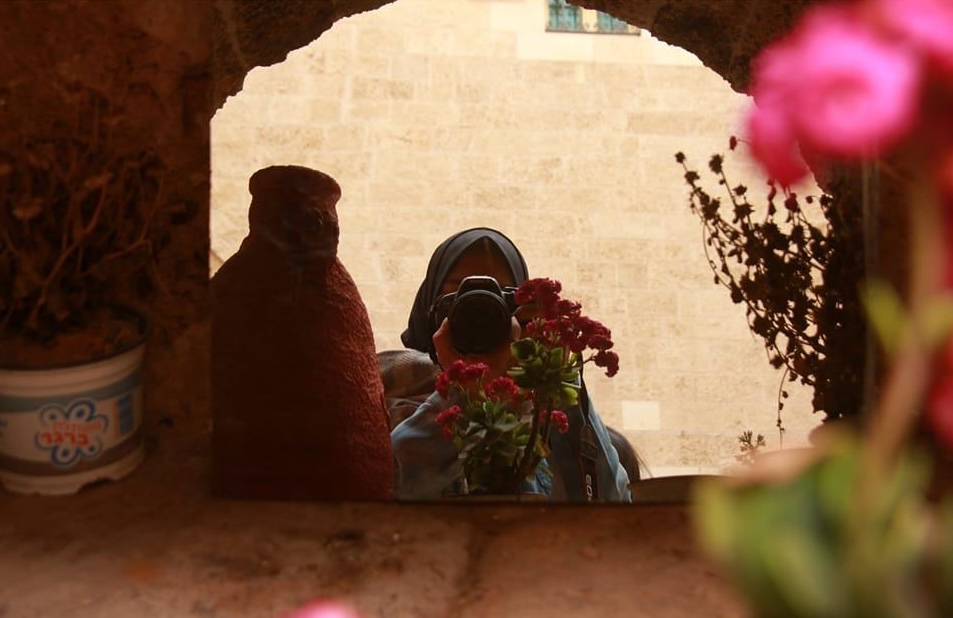
Every day, you walked through the ruined streets and, through your photos and comments, you revealed the convoys of displaced people being forced out again and again, the almost total devastation of the buildings and cultural heritage of the Gaza Strip and, above the layers of destruction, the fleeting smiles of children amid the rubble.
Behind the lens of your camera, you gave your all, in every circumstance, to bear witness to the tragic daily lives of Gazans trapped in the snare of the medieval-style siege imposed for the past 18 months by Israel, an amnesiac, supremacist and racist occupying force.
Your photographic reports, published notably in The Guardian, captured the faces and stories of civilians displaced, mutilated and buried beneath the bombs. Even the Red Crescent relief workers were bombed and then executed by the Israeli army, killed for trying to save those who could still be saved. This was the reality that your work laid bare. You had become one of the most relevant sources of information in Gaza, exposing this genocide to the eyes of the world.
You were born at the very beginning of this 21st century, whose horrors have grown exponentially over the two past decades, while the far right is rising in our outdated, anaemic democracies, mute and motionless in the face of the massacre of your people. Worse still, are they not complicit in this extermination? “Israel and those States that have been complicit in what can be reasonably concluded to constitute genocide must be held accountable and deliver reparations commensurate with the destruction, death and harm inflicted on the Palestinian people”, writes Francesca Albanese, UN Special Rapporteur on the situation of human rights in the occupied Palestinian territories (1).
With more than 210 journalists killed since the beginning of the war, your death has become a new symbol of media resistance in the face of the Israeli relentless drive to silence those who report the news, whatever the cost.
“Genocide is a process, not an act”, she continues. “Settler-colonialism is a dynamic, structural process and a confluence of acts aimed at displacing and eliminating Indigenous groups, of which genocidal extermination/annihilation represents the peak.” Francesca Albanese also denounces the double standards of many governments, which demand accountability from Russia for crimes committed in Ukraine while turning a blind eye to the genocidal acts perpetrated by Israel against the Palestinians.
But let’s get back to you, shall we Fatima, to your all too brief existence. You were 25 when you died, with a degree in multimedia studies. With your photographs you had composed a visual diary reporting and documenting, day after day, the violations of civil rights in the Gaza Strip, the slow or violent death of its inhabitants and the chaos of their survival.
Les us recall that only Gazans themselves can tell what is happening on the ground. Israel has banned foreign media from entering the enclave since the very beginning of the conflict, making any witness an obstacle to its propaganda, which suggests that Hamas members are hidden everywhere, in the homes of Gazans, beneath the canvas of their tents, in hospitals, schools, museums, universities, canteens… and even in the homes of journalists like you, who are sooner or later eliminated.
And yet, under the 1949 Geneva Convention and the subsequent protocols (2), journalists covering conflicts are normally considered as civilians and therefore entitled to protection. Deliberately targeting them constitutes a violation of international humanitarian law and can be qualified as a war crime before the International Criminal Court.
This is precisely what you were doing and why you were killed: documenting this war with its countless violations. In that sense, you were a fighter for the Palestinian cause and for journalism itself. In fact, your unwavering commitment had already led to an extraordinary film project: “Put Your Soul on Your Hand and Walk”, a documentary based on a year of video exchanges between you and the exiled Iranian filmmaker Sepideh Farsi, which was recently selected by the french Association du Cinéma Indépendant pour sa Diffusion (ACID) in Cannes.
“A miracle happened when I met Fatem (Fatima Hassouna). Ever since, she became my eyes in Gaza, while surviving under the bombs and documenting the war. And I became her connection to the outside world, from her Gaza prison, as she puts it”, stated Sepideh Farsi, emphasising the strength and creativity of your cross-border and digital collaboration.
Your radiant energy has also led you to take part in the “She Leads” programme by Plan international, which aims to promote women and young leaders in crisis-affected areas. Through your involvement with youth organisations and your voice on social media, you became an inspiring figure for all young Palestinians and a true ambassador for the cause of women living under occupation.
With more than 210 journalists killed since the beginning of the war, your death has become a new symbol of media resistance in the face of the Israeli relentless drive to silence those who report the news, whatever the cost. But this mortifying blindness fails to grasp what you have left behind: your ability to transform suffering into images imbued with humanity, your daily replenished courage, so many examples that will inspire a whole new generation of journalists and human rights activists, in Palestine and beyond, to follow the path you have paved for us.
Notes:
Report of the UN Human Rights Council published in March 2025, entitled “Anatomy of a Genocide”.
1949 Geneva Convention. Additional Protocol I of 1977 (Articles 79 and 50). UN Security Council Resolution 2222 (2015), specifically concerning the protection of journalists in armed conflicts. Lastly, Article 19 of the Universal Declaration of Human Rights (freedom of expression and information).
Source cover image : Facebook / @fatma.hassona.526
Translated in English by Elizabeth Grech
This investigation was carried out with the support of the AGEE – Alliance for Gender Equality in Europe.