Cette publication est également disponible en : Français (French) العربية (Arabic)
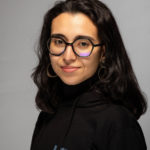
Widad, 25, is a lawyer and former volunteer with Al-Baydar, an organization dedicated to protecting Bedouin rights, founded in 2021 by lawyer Hassan Mleihat. For a year, she documented the violations and attacks endured by residents of the region.
She joined the organization in 2025, “with the aim of defending the rights of Bedouin and marginalized communities.” At the time, Widad was the only woman volunteering in this role within the organization.
A resident of the Bedouin village of Umm ad-Daraj, also known as Az-Zuwaydin, in the Hebron governorate of the West Bank, she has witnessed firsthand the abuses endured by her community. “We have neither transportation nor essential services. Most girls cannot pursue higher education because we have no universities, only primary and middle schools,” she laments.
A significant Bedouin population settled in the West Bank after being expelled from their ancestral lands, beginning with the violent establishment of the State of Israel in 1948. Most of these communities originally came from the Naqab, in southern Palestine, and gradually settled in the West Bank over the following decades, with displacement accelerating after the 1967 war.
The fragmentation of the West Bank, caused by the separation wall, military bypass roads, and the continued expansion of Israeli settlements, has severely restricted these communities’ freedom of movement, forcing them to live in permanent or semi-permanent encampments.
Today, the vast majority of these communities are concentrated in Area C of the West Bank, which is under full Israeli control, where they face escalating violence from settlers seeking to seize more land. Among those directly or indirectly affected by these violent attacks are women and girls, who must contend with both institutional neglect and the brutality of settler assaults.
Colonial violence against women
According to a report by the United Nations Office for the Coordination of Humanitarian Affairs (OCHA), many children, particularly those living in the Hebron governorate, are forced either to cross checkpoints every day or to endure harassment by Israeli settlers on their way to school. These conditions sometimes lead families to withdraw their children from school, with girls being particularly affected.
Women and girls must contend with both institutional neglect and the brutality of settler assaults.
Another essential service lacking in the village is healthcare. Widad deplores the absence of any properly equipped medical facility capable of providing adequate care: “We have no healthcare centers. There is a building, but no adequate medical staff or emergency services. The center only opens on Sundays to vaccinate children.”
And women are particularly affected by this lack of healthcare. Widad documented the case of a pregnant woman who was about to give birth and was being driven to the nearest hospital in the city of Hebron. Despite the urgency of the situation, settlers had barricaded all the roads connecting the village to the city, forcing the woman to give birth in undignified conditions.
In recent months, Widad has gathered extensive evidence of colonial violence against Bedouin women. Much of this violence stems from the fact that residents must pass through a settlement bordering the village to reach their homes, exposing non-Israeli passersby to almost constant danger. This proximity also facilitates repeated attacks, including the stoning of houses.
“Bedouin women spend most of their time at home, which is why they are not targeted as much by settler violence. We are afraid to leave our homes,” Widad says.
She also highlights the risks women face when attempting to stand up to settlers. “We are Muslim women, after all. If a settler hits you or pulls off your hijab, it will change the way society looks at you.”
Aseel, 22, is the organization’s communications officer. She is responsible for compiling the documented violations and attacks, sharing them on social media, and producing detailed reports. The young woman takes pride in the impact of her work: “All the statistics used by Al Jazeera and Al Arabiya are based on figures provided by our organization,” she states.
Trained as a journalist, Aseel joined the organization the same year it was founded. She wanted to put her skills to use in the service of a humanitarian cause. “I believe that the media’s role goes beyond simply conveying information. It also carries a human responsibility, because it helps bring the truth to light and draw attention to issues that deserve to be heard,” she says.
A women’s rights awareness workshop
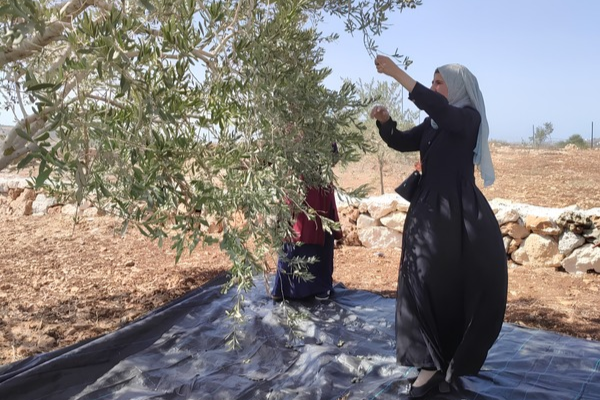
Like Widad, Aseel lives in the West Bank, in close proximity to Bedouin communities. “It’s olive harvest season in Palestine, but settlers are doing everything they can to prevent residents from accessing their land. Many women are afraid to take part in the harvest,” she explains.
Bedouin communities depend on livestock farming and agricultural activities for their livelihoods. These activities are frequently disrupted by settler attacks. As these attacks have become almost systematic, Al-Baydar has launched support campaigns to provide legal assistance to residents, particularly women, who are disproportionately affected by a lack of access to the information they need to defend their rights.
“It’s olive harvest season in Palestine, but settlers are doing everything they can to prevent residents from accessing their land. Many women are afraid to take part in the harvest.”
The organization notably held a rights-awareness workshop for women in Bardala, a Palestinian village in the northern Jordan Valley of the West Bank. Representatives of the organization, including Aseel, trained women on how to assert their rights while helping them understand the laws and policies that shape their daily lives.
Al-Baydar is also working to establish projects supporting women artisans, including seamstresses and emerging craftswomen, by providing them with legal guidance and assistance.
Despite the constant intimidation, Aseel does her best to carry out her work. “Once, I was filming a documentary about policies of forced displacement and repression. A settler approached me and tried to stop me from doing my job. I had to lie and tell him I was only taking photographs so he would leave me alone.”
Aseel refuses to give up and remains committed to supporting these communities, dedicating eight hours a day to the organization alongside her university studies.