Cette publication est également disponible en : Français (French) العربية (Arabic)
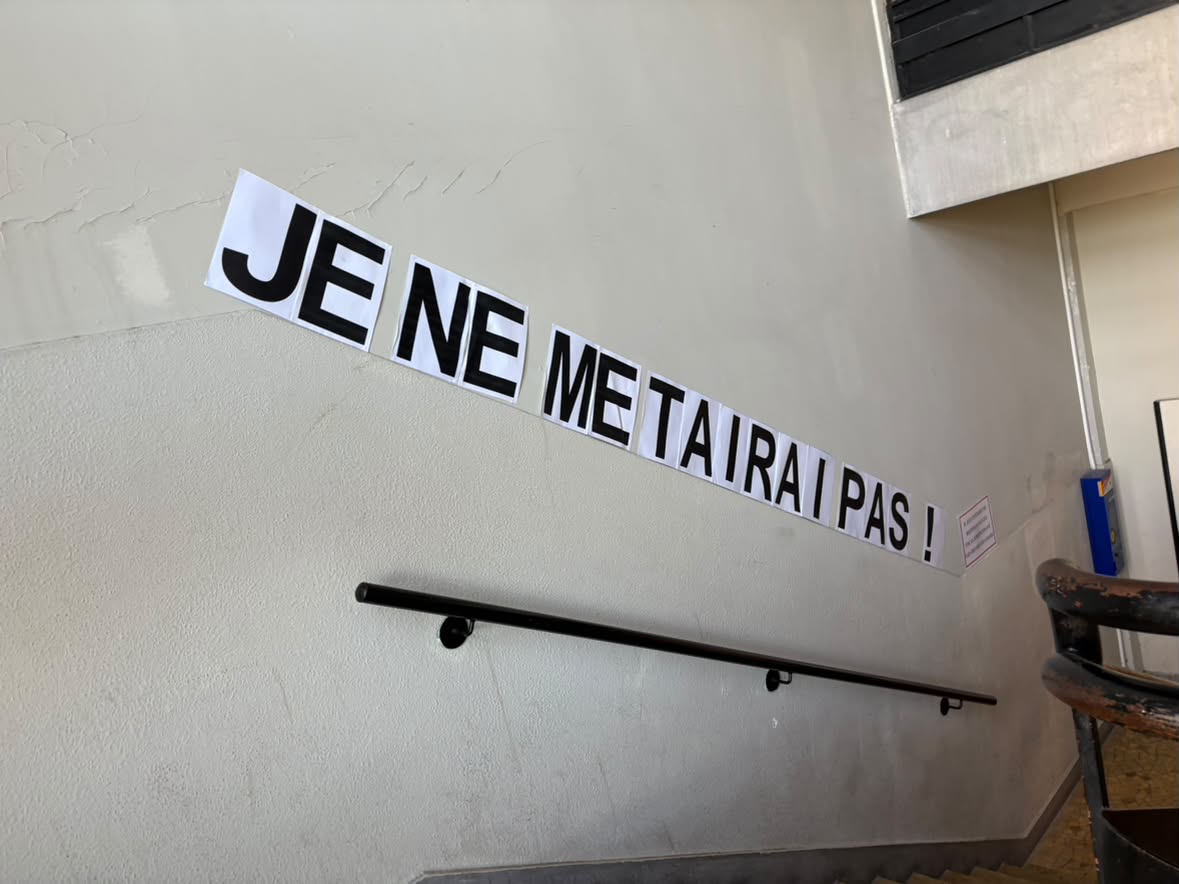
“We were allowed to put up slogans denouncing sexism and everyday harassment in the school’s hallways and stairwells,” says Camille, 17, a high school senior in the Paris region. Reclaiming the streets of major cities after nightfall – or the walls of a high school in broad daylight – armed with glue, white sheets of paper, and black paint: this is what activists and determined young people are doing across France, transforming public spaces into platforms for protest. Their goal is to express the anger of an entire generation of girls and women against a system that has failed to adequately protect them.
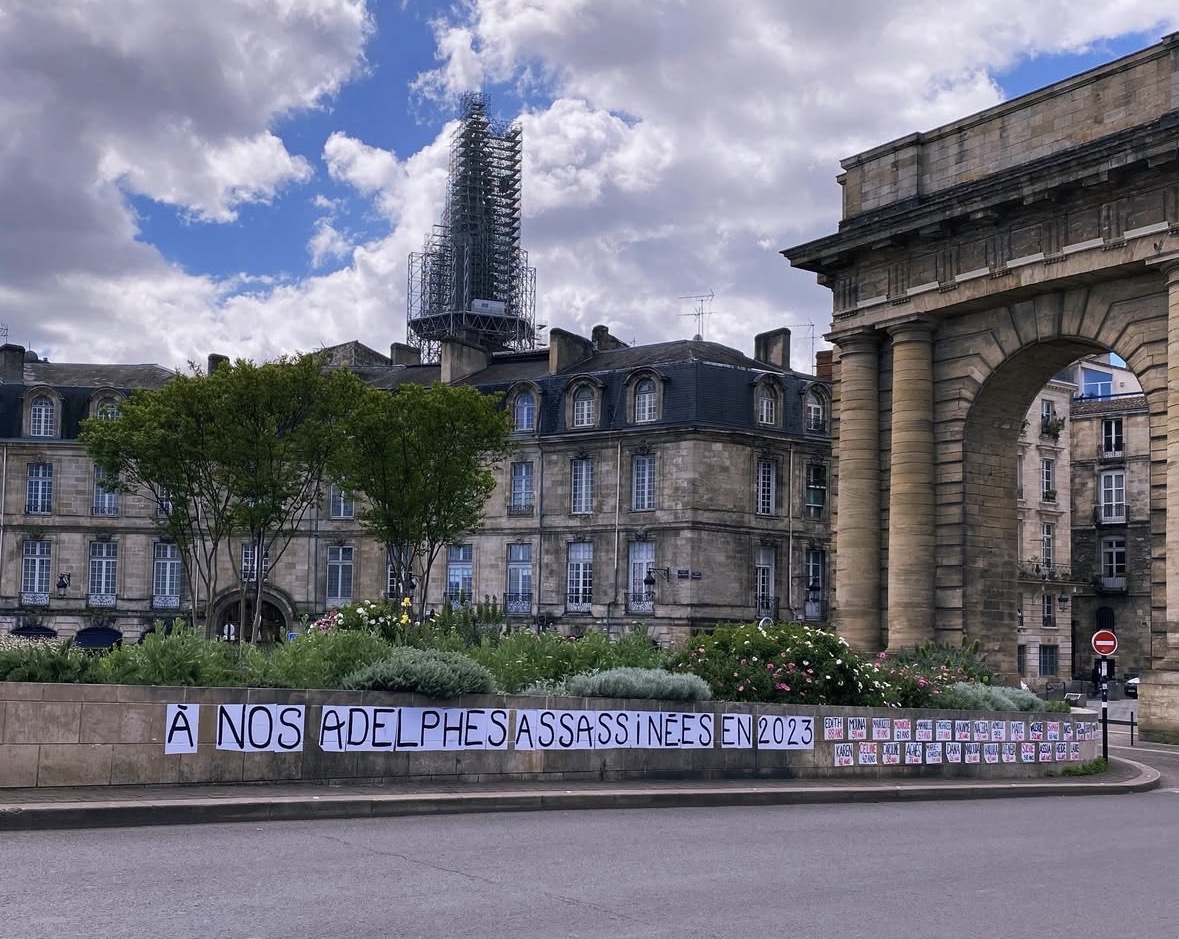
From Paris to Marseille, Lille, and Bordeaux, and even in medium-sized cities such as Angoulême, there are more than 200 local activist groups operating throughout France. They share a distinctive visual aesthetic that has become instantly recognizable: hand-painted black capital letters on A4 sheets of paper, pasted onto walls using a mixture of water and flour. Originally, these grassroots groups operated in gender-restricted spaces that excluded cisgender men during nighttime actions in the streets. Over time, however, the movement has evolved, finding its way into some French high schools, where cisgender boys are also encouraged to participate. Yet whether in the streets or at school, in gender-restricted or mixed-gender groups, these young activists share one conviction: the determination to confront the state’s systemic inaction with the power of words.
The streets and the night: Where the movement began
While political discussions take place during the day in government ministries, the activism of the colleureuses, feminist collage activists, takes over the streets as cities fall asleep. “And we say colleureuses, not colleuses, because we also welcome trans men and nonbinary people,” explains the Collages Féminicides Paris collective (1). This deliberate choice affirms that sexism and systemic violence affect all gender minorities.
It is difficult, however, to establish exactly where the movement began. Some point to Marseille, others to Paris. What is certain is that feminist collage activism emerged in 2019 and spread in waves through local Instagram accounts across many of France’s major cities. Its initial objective was to collectively denounce femicide, street harassment, and sexist and sexual violence.
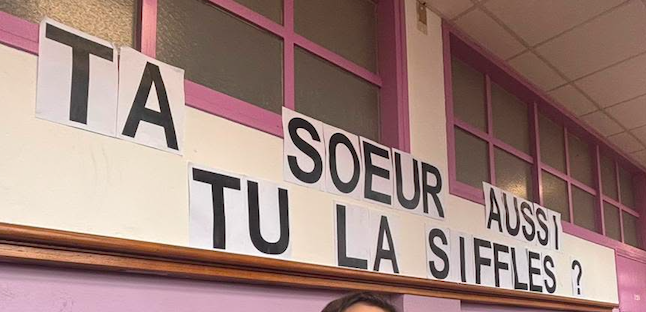
Camille grew up seeing these messages in the streets. “I’ve always seen the collages in the streets… It’s something normal to me, and sometimes, reading them, it felt like they were showing up at just the right moment. They also gave me renewed motivation as a girl… It’s a combination of information and inspiration. That’s what we wanted to recreate at school: denouncing harassment with phrases like ‘Do you catcall your sister too?’ while also inspiring girls and reminding them that they have the same rights as boys, particularly when it comes to choosing their educational paths, with messages such as ‘Same rights, same dreams.’”
In the documentary Riposte féministe (Feminist Riposte) (2), which captured the early days of this uprising across France, the impact of this nighttime empowerment on activists’ everyday lives is evident. As one young woman explains, “Since I started putting up posters, I dress however I want… Go ahead, come talk to me. I’ll scream at you, I’ll swear at you. I’m not afraid anymore!”
Very quickly, the collectives expanded their struggles beyond violence against women to encompass anti-racism, LGBTQIA+ rights, police violence, and sexual crimes against children. More recently, local groups have also taken public stands when, for example, an artist or politician accused of rape was scheduled to perform or run in a municipal election.
“I’ve always seen the collages in the streets… It’s something normal to me, and sometimes, reading them, it felt like they were showing up at just the right moment.”
For these activists, however, expressing their anger and exercising their freedom of speech in the streets has become an increasingly tense and risky undertaking. Gone are the days when collages were tolerated as minor acts of vandalism. Activists now face growing legal pressure and repression, including prolonged periods in police custody and increasingly heavy fines (3).
By displaying their messages in bold black capital letters, they take risks while denouncing a double violence: that perpetrated by aggressors in the streets, and that of a justice system and police force rooted in repression rather than the protection of the public, especially women.
Intersectionality, one brushstroke at a time
Despite this intensifying repression, the movement persists, displaying, for example, the grim tally of femicides that continues to rise month after month, year after year, across France. These are not simply statistics, however, but above all acts of femmage, feminist tributes to women, accompanied by the first names of each victim, restoring to them a face, a life, and an identity, and refusing to let them disappear into the anonymity of official statistics.
At the same time, the collages deliberately name and confront the weight of society’s injustices. Euphemistic or inadequate terminology is rejected: terms such as “pedophilia” give way to more precise language such as “sexual crimes against children.” The messages are direct and incisive, much like graffiti, expressing popular rage at government inaction while giving voice to those who cannot, or can no longer, speak for themselves. It is a way of forcing passersby and political leaders to confront realities that some actively seek to sanitize and render invisible.
For these activists, the struggle against patriarchy can no longer be constrained by the institutional blinders that obscure systemic injustice. This is why, on buildings across French cities, people wake up to find unmistakable and politically charged messages such as: “A democracy does not issue licenses to kill,” “Femicide: The police are complicit,” “Speaking out means breaking free,” “One child killed every five days,” “Free Palestine,” “My skirt is not an invitation.”
Sisterhood after dark, solidarity across genders at school
Yet activism through painting and pasting powerful messages is only one aspect of what defines these collectives. The young activists’ horizontal, nonhierarchical organizing goes further, rooted in sisterhood and mutual safety. When groups head out into the streets together, they keep watch over blind spots and street corners to ensure that every participant gets home safely.
More than a vehicle for political messages, the collective operates as a network of mutual aid and radical sisterhood. Against an increasingly polarized political landscape in France, where their slogans are regularly torn down by hostile groups or washed away by municipal authorities, activists accept the fleeting nature of their work. Why? Perhaps because what matters most remains: the visual impact that leaves a lasting impression on those who encounter the messages the following morning.
High school students share this view, while bringing their own transformation to the movement. At school, the dynamic is shifting slightly to make room for male allies, challenging the original gender-restricted organizing of the street collectives. As Camille explains, “I think it carries more weight when everyone takes part in putting up the posters. We’re all concerned. The cause and the struggle aren’t just for women.”
Teachers also joined the initiative, as the project formed part of a school working group on gender equality between girls and boys. The only restriction? “We had to get the messages approved by the principal’s office… but everything was accepted,” Camille reassures. “We also wanted to show, through this poster campaign, that girls can feel confident and speak out against sexism and harassment… to show them that they are strong and can stand up for themselves, because today, they have support,” she adds enthusiastically.
Yet both in the streets and at school, the posters were quickly vandalized by people who objected to their messages. This destruction did nothing to discourage Camille and her classmates. For them, the demand for justice and the expression of anger are more powerful when they are visible, even if only “a little bit.” Because while slogans can be washed away with water or covered with paint, the spark they have ignited has firmly taken root in the minds of this united new generation.