Cette publication est également disponible en :
The latest feature film by the duo Adila Bendimerad and Damien Ounouri marks a milestone in the history of Algerian cinema because it breaks all its aesthetic and semantic codes. The Algerian public has, for decades, been inundated with social comedies and productions of unequal quality on the colonial era and the war of liberation. A period film on precolonial Algeria is therefore a first.
The Last Queen is the story of a queen, or, more precisely, two queens, the co-wives of the Sultan of Algiers Salim El Toumi. Historians have disputed the existence of the main female character, Zaphira, but the legend of her existence is very strong. The other main female character, Chegga, is a Berber queen, a warrior in the ranks of historical female figures who resisted the various invaders.
The two women fight to protect their families and their country in a grand choreography of blood, fury, and courage. This first real Algerian period film transports us to this beautiful Algiers, coveted by so many for so long.
In 1516, the Spaniards occupied the city. Called to the rescue, the legendary corsair Aroudj Barberousse arrives to liberate the region. The battle scenes set against the magnificent setting of the Algiers beaches, under the light of a clear blue sky, are filmed like a pictorial fresco.
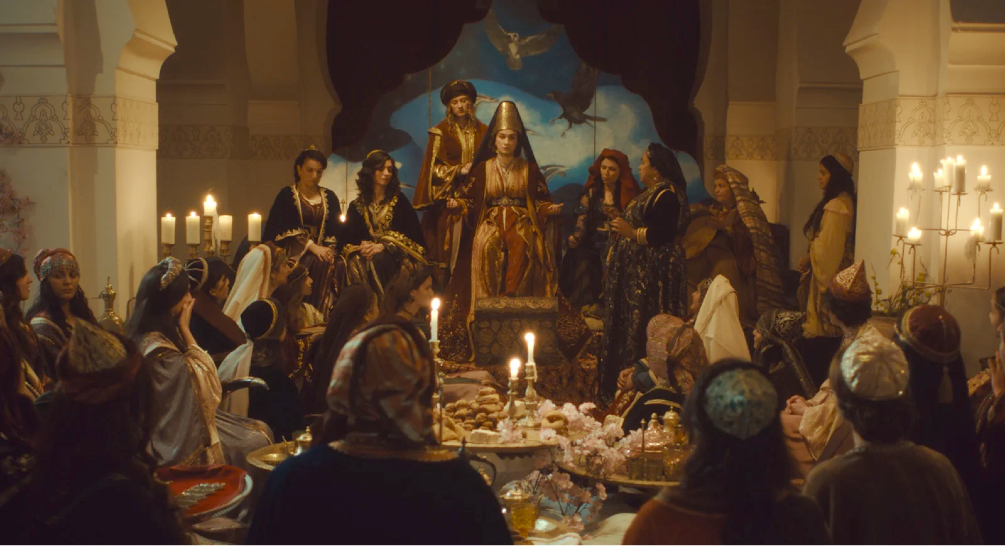
We then move on from armed violence and colliding bodies to the luxury of the royal palace. Zaphira (played by Adila Bendimerad herself), wife of King Salim El Toumi, entertains herself with her female friends, all dressed in sumptuous Algerian costumes. She is mischievous, strong, and passionate. She demands that her husband be more present, that he prepare his young son for his own eventual future as king.
We could claim that The Last Queen is, in a way,
the Algerian equivalent of Barry Lyndon
What we sense at the beginning of the movie proves to be true when Barberousse, after finally defeating the Spanish invader, joins forces with King Salim and climbs to the highest ranks of power. But the pirate, supported by his brothers and their men, is not satisfied with this success. He also wants to take Algiers, and its queen, Zaphira, too: “I will take his palace, and I will ride his horse, and his wife!” he proclaims to his companions.
King Salim is soon found murdered in his hammam. As tradition dictates, Zaphira, now a widow, must return to live with her family and take her son with her. But she refuses to abdicate and holds her own against her brothers and the onslaught of Barberousse’s requests to marry her.
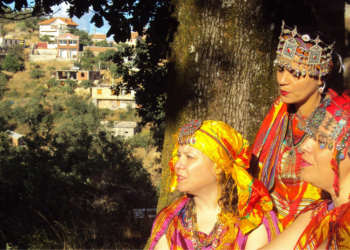
The work that Adila Bendmerad and Damien Ounouri have produced succeeds in paying homage to strong, authentically Algerian female figures—women who speak Algerian, who wear Algerian clothes, and who evolve in interiors like those that still exist and can be visited in the capital, in Tlemcen, and in Constantine. Genuine identity markers that are so often excluded from audiovisual productions.
What this film brilliantly accomplishes is how it reinvents, so to speak, period costumes that manage to echo the outfits Algerian women still wear today. In that sense, we could claim that The Last Queen is, in a way, the Algerian equivalent of Barry Lyndon.
Like in Stanley Kubrick’s masterpiece, released in 1976, the effort to reconstruct displayed in The Last Queen is remarkable: reconstructing an era and evoking its entire ambience, down to the dress code. Stanley Kubrick’s work won him the Oscar for Best Costume Design. But the filmmaker had at his disposal books, paintings, and archival material as references for every last detail. Adila and Damien had to recreate and reconstruct with only snippets of history to work from, making mere shreds of heritage speak and project us back into 16th-century Algiers.

During the recent avant-première in Paris, Adila confirmed how difficult it was to bring this era to life in visual form: “Colonization erased the cultural heritage of Algiers. It was necessary work to recreate the costumes, to give Algiers back its Mediterranean-ness, its African-ness,” she said.
A member of the film crew remembers that they’d been able to find a wealth of documents on the types of outfits the Spanish soldiers wore, but not even a clue as to what the Algerian fighters of that time used to wear. In fact, the Algerian spectator has only ever seen, in both national and foreign productions, costumes inspired by the Arab-Muslim culture of a fantasy Orient, one where the “Arab” constantly oscillates between the destitute dressed in tattered djellabas and the Sultan covered in gold and precious stones.
The Last Queen is therefore paving the way for other filmmakers to think up ways to recreate different periods of the country’s history. A different angle is indeed possible. Adila and Damien’s vision does justice to the luminous, Mediterranean Algiers, with images of Tipaza and its Roman ruins, a reminder that precolonial Algeria “was not a simple pebble,” as Damien Ounouri says, but a civilization, a people, a culture.