Cette publication est également disponible en : Français (French) العربية (Arabic)
For the past few years, feminist self-defense classes and workshops have been organized in Algiers through word of mouth, outside the sphere of social media. In 2019, a training course for instructors was held in the Algerian capital at the initiative of several feminists, including activist Souad Bentelghoula. This led to the creation of the El Fahlate collective (“the brave ones”), which continues to offer workshops today.
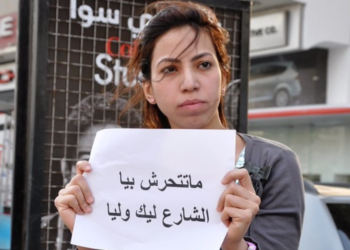
Participants show up in sportswear and may be hesitant at first. But as the discussions and training progress, they gradually relax and become more confident. The women range in age from their twenties to their sixties and come from different social backgrounds. The training takes place in the premises of a community organization, in a supportive atmosphere filled with shared experiences, laughter, emotional moments, and a strong sense of sisterhood. For some, these sessions become an opportunity to discover their own strength, both mental and physical, and to recognize new possibilities. “My attitude changed after I attended an introductory feminist self-defense workshop,” Lynda shares. “I feel more confident, I’m less afraid, and it shows. Recently, I stood up to a man who was harassing me in the street by shouting at him. I was so angry that he simply ran away. This time, I allowed myself to be angry.”
The many lessons of self-defense
Hayat Rammache, a legal professional, feminist, and member of El Fahlate, explains how self-defense can become a fundamental tool in everyday life. “Through training,” she says, “we internalize self-defense techniques. We move from a feeling of fear to an experience of strength. Sharing experiences with other women brings us closer together, opens up new perspectives, and helps us let go of guilt. The first few times I practiced self-defense, it became obvious to me that my life matters and that I have the right to defend myself.”
“There is a whole process to go through,” she continues, “before reaching the stage of physical self-defense. We learn to recognize and set our boundaries, and it is often with people close to us that we need to use these tools. Outside the home, it is mainly about dealing with harassers, but not exclusively. These skills also apply to everyday interactions. The women we train often tell us that there was a before and an after. The experience transforms them.”
“I feel more confident, I’m less afraid, and it shows. Recently, I stood up to a man who was harassing me in the street. […] This time, I allowed myself to be angry.”
Khadidja Boussaid, an urban sociologist and member of the collective, adds, “Although physical self-defense is an important component, we begin with mental, emotional, and verbal self-defense. This practice allows us to deconstruct what we have internalized about violence, the different types of aggressors, and the forms aggression can take.”
Feminist self-defense is not simply about learning how to strike back. It is about giving oneself permission to say no, defending oneself, sharing experiences of successfully standing up to violence, recognizing when violence is escalating and knowing how to respond, whether by escaping or fighting back. It also involves managing emotions and developing compassion for oneself and other women. The practice helps build self-confidence.
“During the workshops, we share a toolkit of emotional strategies for managing what happens during and after an assault, as well as tools for care,” Boussaid explains. “What made me feel stronger was training alongside other women, hearing about their experiences, including situations I had never personally faced, and learning how they resisted or managed to get out of them. This includes situations of domestic violence, for example. We also become aware of the impact of violence on mental and physical health and develop strategies to build confidence.”
To make their methods more widely accessible, the collective has produced the Practical Guide to Feminist Self-Defense DZ in Darja (Algerian Arabic) and French. Its opening pages state that “feminist self-defense is passed on and shared among women, and the element of surprise is one of its pillars.” The guide is distributed during workshops and passed along through word of mouth, almost like a secret tool of protection.
El Fahlate has also joined an international feminist self-defense network. Boussaid describes some of the new approaches she has encountered through this network: “In the group, a young woman spoke about the training sessions she conducts with children using storytelling, helping them identify situations of violence and talk about them. We also discussed anti-racist self-defense and the realities faced by people who experience racism. Intersectionality is essential to self-defense.”
“We need to understand the specific forms of violence directed against women, learn how to counter them mentally, and then give ourselves permission to fight back.”
Confronting misogyny and racism: Adapting self-defense practices
Souad Bentelghoula is a pharmacist and feminist from Oran. She lived in Algiers for several years before moving to Bordeaux in 2019. In 2015, she learned Wendo—a name combining “women” and do, the Japanese word for “way”—a form of feminist self-defense developed in Canada in the 1970s that combines physical and mental techniques. She trained through an international network alongside nearly 60 women. She subsequently participated in numerous workshops and co-initiated the training program that gave rise to El Fahlate.
“What struck me most was becoming aware of my own strength,” she shares. “We hit punching bags, we box! Since then, self-defense has never left my life. Beyond the individual benefits, it creates bonds of solidarity that emerge from the very structure of the training. Wendo teaches us to unlearn the habit of not defending ourselves. We need to understand the specific forms of violence directed against women, learn how to counter them mentally, and then give ourselves permission to fight back. What we do in Algiers is based on the Riposte approach. We have adapted the scenarios we practice to our own context, focusing on street harassment and everyday violence, drawing on our lived experiences.”
Bentelghoula has also co-facilitated several workshops in France, including sessions for racialized women and women from immigrant backgrounds. “After I moved to Bordeaux, a group of women and I quickly formed a self-managed self-defense group,” she explains. “Through conversations with a friend, I became aware of the need to defend ourselves against racism. We developed tools and approaches for responding to racist aggression. For example, we introduced exercises to help each participant become aware of her position within a system structured by racial and colonial power relations. We form a circle to discuss privilege (whether or not someone has French citizenship, whether or not they have received formal education, whether or not they are perceived as white, and so on) and the discrimination that results from these differences.”
“This is a form of popular education: understanding more so that we can respond more effectively. In the scenarios we choose for verbal and mental self-defense training, we don’t focus exclusively on sexism. Nearly half involve racist situations. For the past two years, those preparing the training sessions have drawn on current feminist issues,” she concludes.
Hayat, Khadidja, and Souad all want to continue passing on their knowledge. Hayat and Khadidja hope to train more women across Algeria. “I want these tools to be accessible to all women,” Hayat insists. Souad, alongside her involvement in feminist and anti-racist self-defense internationally, also hopes to continue strengthening the practice in Algeria. All three emphasize that women should not have to settle for merely surviving. Every woman has the right to live with dignity and to defend herself.