Cette publication est également disponible en : Français (French) العربية (Arabic)
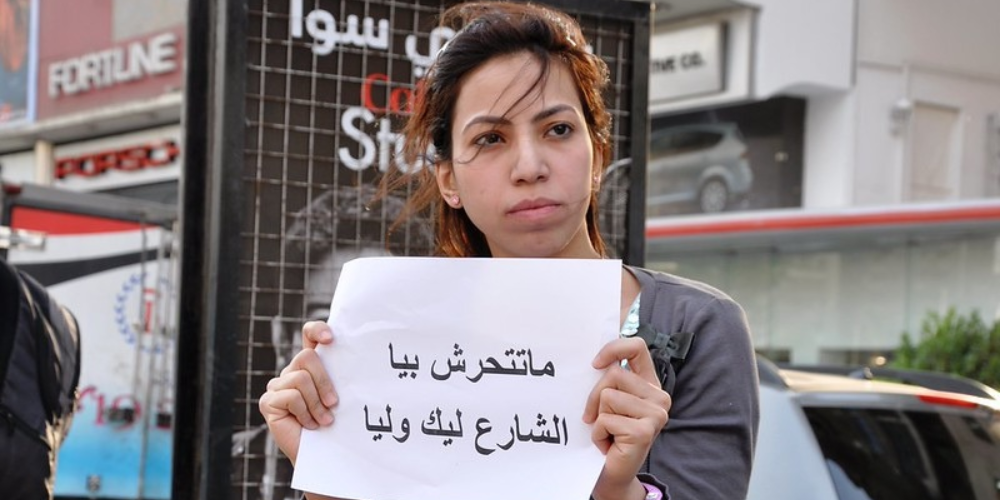
Tomorrow, November 25, the world marks the International Day for the Elimination of Violence against Women. The date also marks the beginning of the 16 Days of Activism against Gender-Based Violence. To mark this occasion, Medfeminiswiya is publishing a special dossier on street harassment, perhaps one of the most common and most normalized forms of violence against women.
Whether it is called harcèlement de rue in France, catcalling in Italy, or التحرش في الفضاءات العامة (harassment in public spaces) in Arab Mediterranean countries, this form of violence has long been met with silence. Yet, according to several studies, it is among the most widespread forms of discrimination against women.
Public space remains male-dominated territory, forcing women who venture into it to adopt strategies of invisibility and avoidance.
Describing, documenting, and denouncing these acts of aggression in all their forms—unwanted remarks, persistent advances, insults, intimidation, unwanted touching, groping, sexual assault, and more—is already a first step toward breaking the wall of silence and developing strategies of resistance. This is what Louise Aurat sets out to do in her five-part podcast, “Regardez-vous pas nous” (Look at yourselves, not at us), which draws on deeply personal experiences. In it, Aurat and other women share their experiences and, moving beyond their individual stories, develop a broader reflection on this form of gender-based violence and what it reveals about the societies we live in.
In her article, Wiame Awres explores the feminist self-defense workshops that have been organized in Algiers in recent years. Also in Algeria, Nadjoua Rahem examines TBD Algeria, a Facebook platform that breaks taboos surrounding sexual assault and harassment in streets and on public transportation through online awareness campaigns. In Italy, Federica Araco highlights a particularly important initiative: the Rome-based association Donnexstrada and illustrator Michela Negri have joined forces on a publishing project that amplifies the voices of survivors of street harassment. The project is designed as an educational tool to raise awareness among secondary school students.
From sidewalks to public transportation, from the streets of Algiers, Tunis, and cities across Egypt to those of Rome, Paris, and Casablanca, street harassment is not inevitable. Above all, it should not be up to women to learn how to avoid the streets, but rather up to society to ensure that they can move through them, inhabit them, and enjoy them freely. Without fear, without being pressured into silence, and without constantly having to protect themselves.