Cette publication est également disponible en : Français (French) العربية (Arabic)
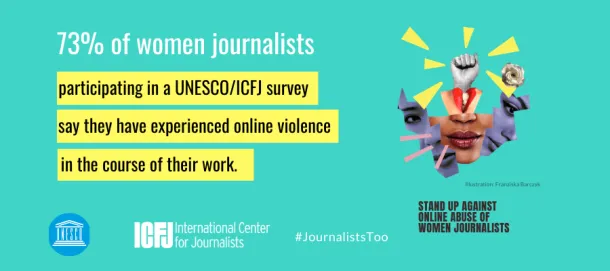
Nearly three out of four female journalists worldwide have been victims of online violence, according to a major UNESCO study conducted in 2020. The latest data from the United Nations Educational, Scientific and Cultural Organization shows a worsening of this phenomenon, fueled by artificial intelligence and the rise of authoritarianism.
A 2025 study by Reporters Without Borders (RSF) also found that, in more than 110 countries, journalists covering women’s rights, gender-based violence, and sexual violence are particularly at risk.
Many victims have spoken out publicly: Linh-Lan Dao, a French journalist at France Télévisions, Salomé Saqué, a French author and freelance journalist at Socialter, and others around the world, such as our Lebanese contributor Fatima al-Bassam, who recounted on our website the attacks she suffered in October 2024 in the context of the war in the Middle East. Their testimonies help us understand that online violence truly endangers those affected and threatens freedom of expression as well as the right to information.
Élodie Vialle specializes in the protection of journalists and has extensive experience in the field, particularly as a trainer and consultant for organizations defending freedom of expression. In France, the Civil Society of Multimedia Authors (SCAM)—which manages the copyrights of French journalists, among other things—organized a free workshop in April 2026, led by Vialle, for its members. The goal was to “provide tools” for dealing with cyberharassment. Medfeminiswiya participated in this intensive, half-day information and awareness session and shares the practical lessons learned here.
Stay informed, report, document
The first step in combating cyberharassment is to clearly define it, in all its forms, in order to better identify it. PEN America provides the following definition: the “pervasive or severe targeting of an individual or group online through harmful behavior.” On its website, a self-defense manual is available in five languages (including French, English, and Arabic), featuring a glossary of several cyberbullying tactics followed by possible responses.
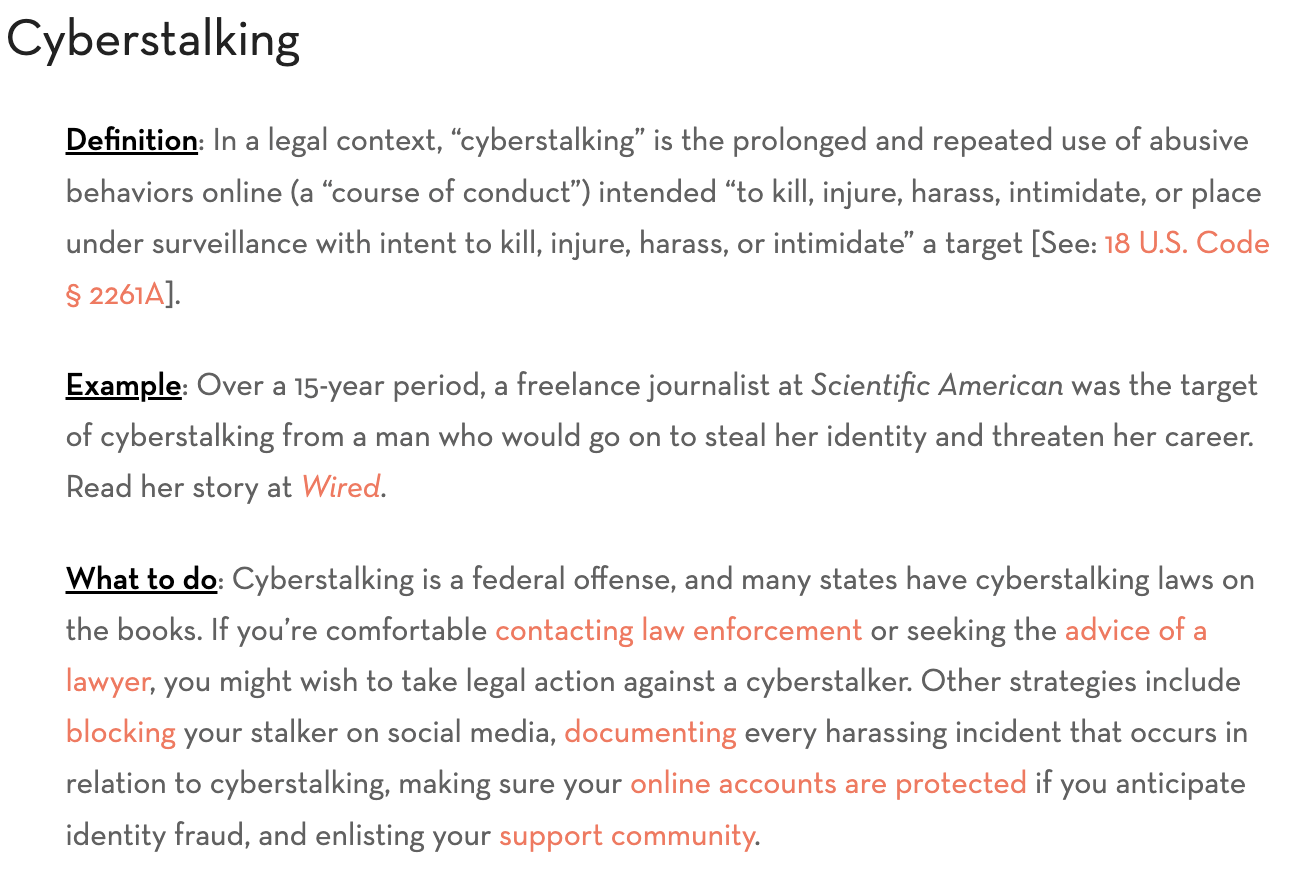
Screenshot from the online glossary compiled by PEN America.
There are indeed various types of attacks (ranging from AI-altered photos to deepfakes and doxing, the publishing of sensitive personal information online), and the ways to protect oneself against them are not always the same. “It’s important to have the right vocabulary in mind, because when we report incidents, we can describe exactly what happened,” explains Élodie Vialle.
The trainer also emphasizes the need to report incidents to the relevant platforms, even if this doesn’t always seem effective: “When filing a complaint, or if a lawyer wants to escalate a claim, for example, it’s more difficult if no report has been filed.” As a reminder, in France, cyberbullying is a criminal offense punishable by up to three years in prison and a €45,000 fine. Pointing this out to harassers can also be a possible first step.
Another important step is to document instances of online harassment from the very beginning, with screenshots.
Strengthen your cybersecurity
A series of cybersecurity measures should be implemented as soon as possible to protect yourself, such as: strengthening your social media privacy settings, setting up Google Alerts for your name, clearing your online footprint (an old resume or blog, etc.), using a different password for each site with a password manager, enabling two-factor authentication on social media, using private messaging apps, covering your camera lens, and avoiding public Wi-Fi networks.
Élodie Vialle recommends maintaining a balance between work and personal life. This means: keeping separate email accounts, having two computers and phones if possible, and talking to those around you about cyberharassment to identify sources of support at work and among your loved ones. Not staying isolated is essential for maintaining your mental health.
Protecting yourself emotionally
It’s common to hear people say “log off” when dealing with online harassment—a suggestion that’s easier said than done, especially when your job requires you to be visible online. In any case, it’s a good idea to disconnect from social media at least an hour before going to sleep. Vialle recommends installing a breathing exercise app on your phone, using tools like the Feelings Wheel to put your feelings into words, or relying on accessible online stress assessment tools.
In short: take care of yourself. Vialle quotes feminist essayist and poet Audre Lorde: “Caring for myself is not self-indulgence, it is self-preservation, and that is an act of political warfare.”
If the mental burden of cyberharassment becomes too heavy, one solution may be to ask a third party to take certain actions, such as reporting the incident: a trained member of the editorial staff, a supportive friend or family member, or a specialized organization (such as Access Now or Tech4Society).
In short: take care of yourself. Vialle quotes Audre Lorde: “Caring for myself is not self-indulgence, it is self-preservation, and that is an act of political warfare.”
Helping your peers
Et si cela arrive à une de ses consœurs ou confrères, comment réagir ? D’abord l’écouter, sans l’interrompre. Penthis ser à sa propre sécurité avant d’agir et toujours respecter le consentement de la personne. Rassurer, ne pas minimiser. Et partager ces ressources, conseils avec elle ou lui !
Some additional resources
Take a Shira quiz to see if you can spot phishing (an online scam that starts with some form of communication).
Check how secure your password is (by entering an equivalent, not your actual password), here.
Check if your email address has been exposed in a database using the Pwned website.
Discover the multilingual platform Access Now, which offers digital security services to activists and NGOs and can also respond to attacks 24/7.
Reach out to advocacy organizations such as Feminists Against Cyberbullying.