Cette publication est également disponible en : Français (French) العربية (Arabic) VO
Street harassment is the most widespread form of sexual harassment experienced by women in Italy. According to the Italian National Institute of Statistics (ISTAT), this phenomenon, commonly known as catcalling, affects 26.6% of women aged 14 to 65. A scientific study conducted by the University of Milan-Bicocca reveals that, in most cases, this harassment takes the form of whistling, vulgar remarks, suggestive looks, winking, and honking, sometimes accompanied by sexually explicit gestures, such as masturbation, or even stalking or being followed by car. More than half of the 2,764 women surveyed also reported experiencing unwanted sexual touching, while 97% reported negative psychological effects and a diminished sense of safety.
“Street harassment, like other forms of gender-based violence, is an instrument of male oppression aimed at reinforcing the status quo and the power imbalance between genders by restricting women’s presence in public spaces,” writes Chiara Sparascio, a social psychologist and the author of the study, highlighting the profound implications of a phenomenon that is often underestimated.
Although Italy has no law specifically criminalizing catcalling as a distinct offense, it can be prosecuted under Article 660 of the Penal Code, which covers harassment or causing a disturbance to another person and carries a penalty of up to six months in prison or a fine of up to €516.
DonneXstrada: Women in the streets
It is against this backdrop that DonneXstrada (“Women in the Streets”) operates. Since 2021, the association has been working on the ground to combat gender-based violence. DonneXstrada has established 945 Punti Viola (“Purple Points”) across Italy: these are first points of contact located within existing businesses or cultural centers, where women experiencing violence can seek support from people trained to respond to requests for help.
In addition to promoting “collective literacy” through targeted training programs in businesses and schools, the association runs prevention and awareness campaigns aimed at challenging the narratives perpetuated by the media and institutions, which often absolve perpetrators of responsibility by shifting the blame onto victims.
The association’s creative director and co-founder, Bianca Hirata, has also launched numerous Instagram series addressing sensitive issues such as mental health, harassment, and toxic relationships. Many of these projects have involved illustrator Michela Negri, also known as Meriodoc, a 30-year-old artist specializing in sex education.
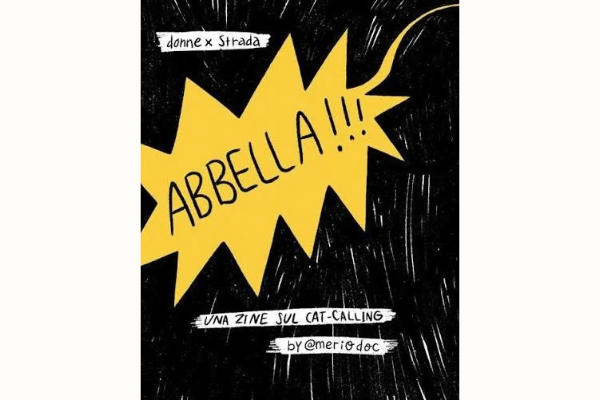
“A while ago, we posted about catcalling and received around 300 comments from our readers, who broke a deeply entrenched taboo in Italy, where people tend to think it’s better not to talk about certain things because it’s considered improper,” explains Hirata. “Many of the incidents they described actually dated back to their childhood or adolescence, and we felt it was important to bring their testimonies together in a zine, which we called ABBELLA!!! [a common Italian catcall roughly meaning ‘Hey, beautiful!,’ editor’s note]. I selected the stories, and Michela created the illustrations.”
DonneXstrada has established 945 Punti Viola (“Purple Points”) across Italy: these are first points of contact located within existing businesses or cultural centers, where women experiencing violence can seek support from people trained to respond to requests for help.
The power of illustration: “a punch in the gut”
The result is a “striking graphic collection of raw, unfiltered testimonies about unwanted compliments,” available online for free. The publication has already begun circulating in schools as an educational awareness-raising tool and is particularly aimed at teenagers, explains Michela Negri.
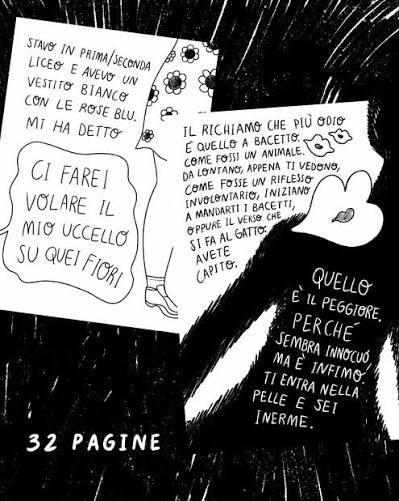
“Many of the people who downloaded it are teachers, which confirms that we’ve reached the audience we were hoping to reach,” she says. “I didn’t want my drawings to soften the subject matter, so I adopted a style quite different from my usual work, which is much more colorful, playful, cheerful, and illustration-driven. I wanted to create something stark and impactful, and I think the choice of black and white preserves the seriousness of the subject. I wanted the content to feel like a punch in the gut.”
Her dark illustrations leave a lasting impression, much like the indelible scars left on those who have tried in vain to erase these traumatic experiences, whether out of pain or shame.
“For you, I’d become a pedophile,” recalls one of the many voices in this collective account, describing what a stranger said to her on the beach when she was ten years old. “Hey, big panther! Want a ride?”, “Look how well you lick that ice cream!”, “Hey, beautiful!”, and “Look at those breasts!” are among the other remarks shouted by men in the street, often accompanied by whistling and meowing.
“The kind of whistling I hate most is the one that comes with little kissing noises,” says another woman who shared her testimony. “[…] From a distance, as soon as they see you, almost like a reflex, they start blowing little kisses at you, or making that noise people use to call a cat, you know what I mean. That’s the worst, because it seems harmless, but it’s disgusting. It makes your stomach turn, and you feel defenseless.”
When we talk about catcalling, explains Michela Negri, there is often this idea that women should almost be happy, or at least flattered, to receive a compliment in the street. “The idea that ‘You’re still young, you should be happy people are complimenting you, because in a few years they won’t anymore; it means you’re still attractive!’ is still very widespread. But the difference between a compliment and harassment lies in the intention and the way it is expressed. Context makes all the difference.”
The project also became a powerful, cathartic collective ritual, Hirata adds. “Many readers thanked us for helping them reconnect with a part of their own history. Finally being able to share it gave them a sense of strength.”