This post is also available in: Français (French)
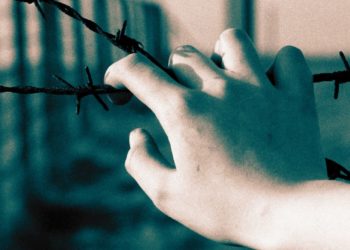
Sadia Hessabi was nearing the end of her thirteenth year: a young girl with big dreams growing up in an unstable country torn apart by conflict. “At 14, I understood that my childhood was over,” she says. Born in 1976 in Kabul, Afghanistan, Sadia endured a childhood marked by immense hardship and suffering. At just 14 years old, she lost both of her parents. She knew then that she had no future in her country. For a 14-year-old girl, there was no way forward; the schools had closed and civil war was raging.
“I knew that I could no longer go to school and that I had no rights left, no other choice but to leave,” she recalls.
Escape was the only way out
The 1990s were a particularly turbulent decade in Afghanistan, marked by civil war and the Taliban’s rise to power. After the Soviet withdrawal in 1989 and the fall of the Moscow-backed government in 1992, various mujahideen groups fought for control of the country. The capital, Kabul, was largely destroyed.
For women, the fighting brought widespread insecurity and increasingly limited access to education and employment.
In Afghanistan, after the death of parents, it is relatives who decide the future of the children, and if the child is a girl, the situation often ends in a forced marriage to men much older than them, sometimes more than 50 years their senior. In 2021, the United Nations Children’s Fund (UNICEF) estimated that 28% of Afghan women and girls aged 15 to 49 were married before the age of 18.
Nevertheless, Sadia, despite being a minor, decided to take control of her own destiny and firmly refused to accept this fate. That is why, despite the extreme risks, she chose to resist and follow a different path.
This young girl, who was boarding a plane for the first time filled with anxiety and uncertainty, set out on the road to exile. She left her homeland for Moscow, then Prague, before finally arriving in Paris.
Life in exile
Paris symbolized a new beginning for Sadia, a place where she could take control of her life, on her own terms. She didn’t know how to start over in France and faced numerous challenges, including learning the language, adapting to the lifestyle, integrating socially, and navigating cultural and societal differences. “I didn’t speak French, and it was very difficult for me to express myself,” she shares. “I was afraid to go out and meet people. I felt very isolated.”
Sadia says that upon arriving in France, she went back to her true identity and actual age. Feeling safe and secure in the capital, she immediately enrolled in school and made learning French her top priority. “Starting school wasn’t easy. I found myself surrounded by children who were immersed in their carefree world, while I felt older and more scarred. Having grown up amid suicide bombings and explosions, I had no memory of ever really having a childhood. Still, I went on with my studies. I earned my nursing assistant diploma and started working at a hospital in Lyon.”
As Sadia looks toward a bright and promising future, women and girls in Afghanistan are currently living under some of the harshest conditions imposed by the Taliban regime.
Nostalgia for her homeland
Despite the years that have passed since she fled Afghanistan in 1991, Sadia still carries the heavy burden of her past. She didn’t want to talk to anyone about it, not even about her country. Though she wasn’t responsible for the war, the destruction, or the loss of her parents, she still felt shame and a sense of despair whenever she heard news of suicide bombings and explosions in Afghanistan.
It was then, during her pregnancy, that an idea came to her to put an end to this painful feeling. From then on, she decided to show a better image of her native country to the French—and to her children, to bring peace to her mind.
She wanted them to know about their country of origin and Afghan cuisine, because it was essential to her that they discover the culture and history to which they belong through their roots. “I wanted to pass on this heritage to my children so that they could grow up with a positive image of their origins and be proud of them,” she shares.
From hospital nurse to restaurant chef
Afghanistan is home to a rich, flavorful, and diverse culinary tradition. Yet in Europe, and especially in France, Afghan cuisine remains largely unknown. The years of conflict have led the world to see Afghanistan only as a country of destruction and devastation. Successive wars have prevented cultural figures from introducing the nation’s cuisine to restaurant menus outside of Afghanistan.
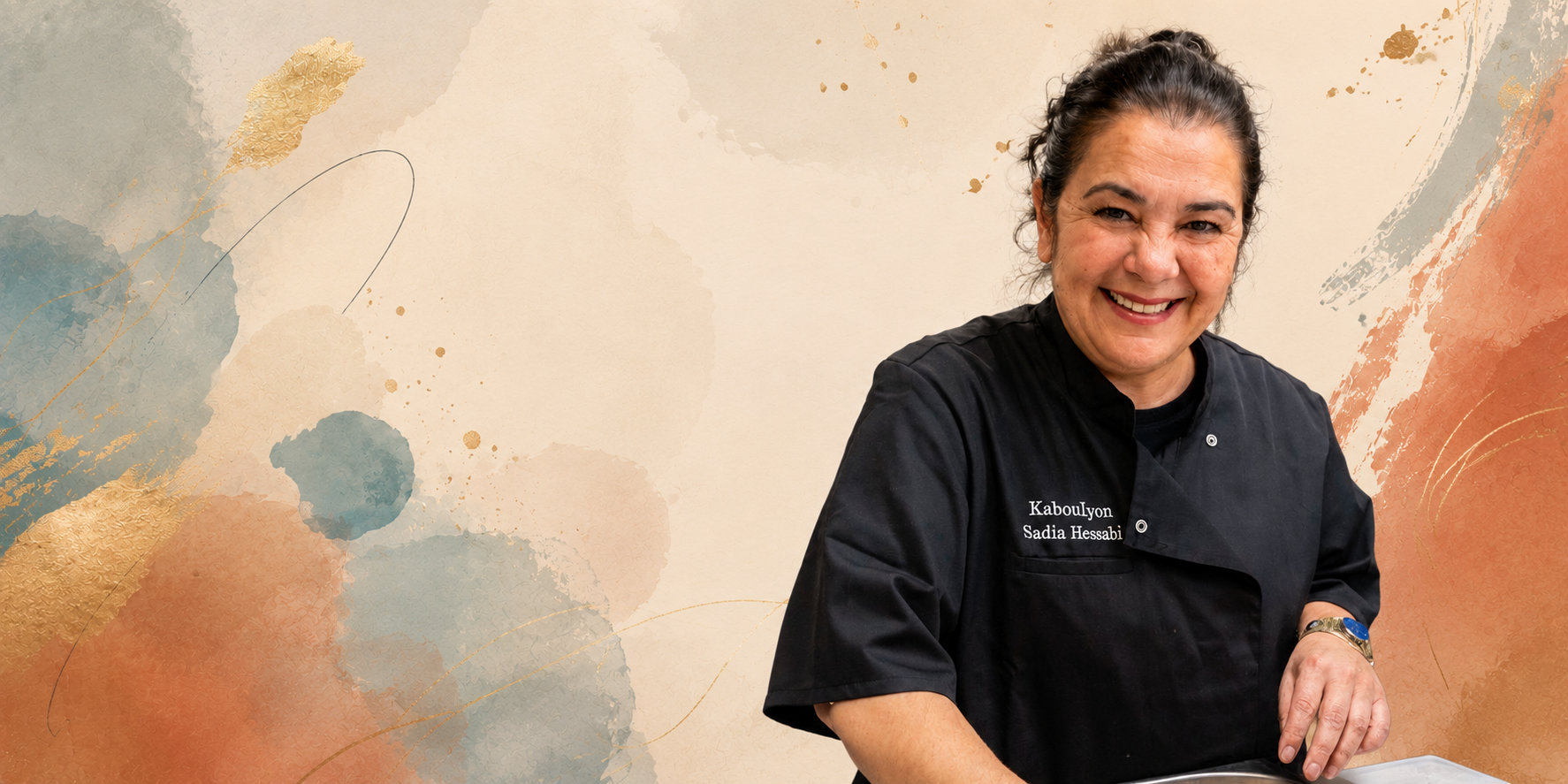
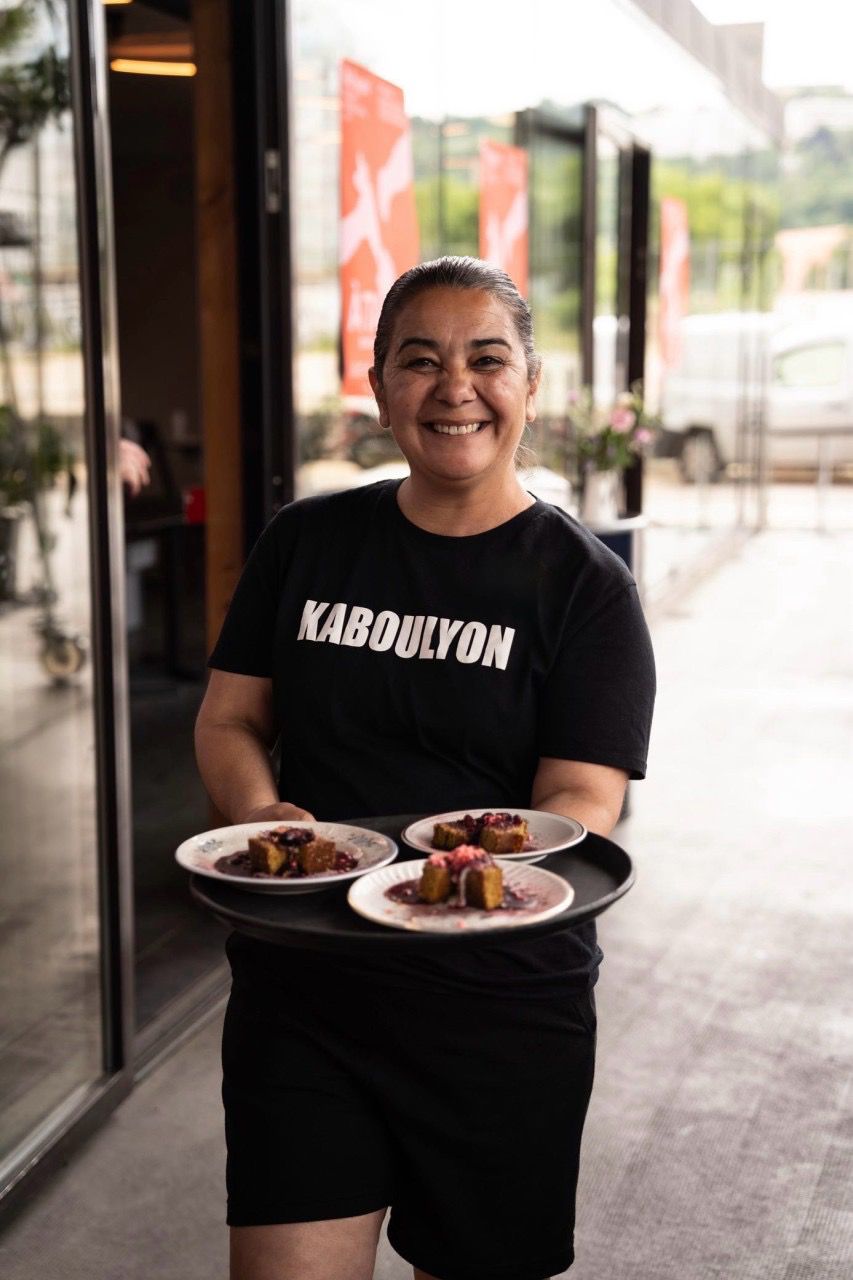
Determined to change that perception, Sadia Hessabi resigned from her position at the hospital and dedicated herself to promoting traditional Afghan cuisine in France. “For me,” she says, “it was very important to change people’s perceptions of Afghanistan. For years, I struggled to figure out how to do it. Then it occurred to me that Afghan cuisine could be the best way to begin. I wanted to show that Afghanistan is a country rich in culture and traditions. So I gave up my job as a nursing assistant and opened a restaurant called Kaboulyon, a combination of Kabul and Lyon.”
Sadia’s life has been marked by extraordinary hardship. Her courage and resilience in the face of life’s trials prove that determination and strength are not defined by gender, and that women are fully capable of forging their own path toward a better life. Sadia’s story offers hope to young girls and future generations.
But her work on behalf of Afghanistan does not end there. Her forthcoming cookbook, featuring recipes and key information about traditional Afghan dishes, is expected to be published by Editions Marabout (Hachette) and made available to the general public very soon, by the end of 2026.
As Sadia looks toward a bright and promising future, women and girls in Afghanistan are currently living under some of the harshest conditions imposed by the Taliban regime. Since seizing power in 2021, these fundamentalists have systematically enforced increasingly restrictive laws against women.
Today, the Taliban severely restrict most activities for women outside the home and continue their efforts to erase them from public life. In Afghanistan today, no woman can freely pursue an education like Sadia did, let alone own and run her own restaurant.