Cette publication est également disponible en :
In the recording, the soldier asked his young wife: “So are you giving me the permission?” “Yes”, she replied, “but don’t forget to use condoms.”
Initially suspected of serving Ukrainian propaganda, the reliability of this recording has sparked much debate. However, Mark Krutov, journalist for Radio Free Europe, managed to contact the couple who confirmed the dialogue. Their names? Roman Bykovsky, serving in the 108th Air Assault Regiment and the woman is called Olga Bykovskaia.
The two young individuals are respectively aged 28 and 25 and, alas, have a 4-year-old son. It is impossible not to be horrified by the normalization of sexual violence, especially since the conversation turns the rape scenario into a trivial detail of the couple’s relationship. Whether a woman finds it conceivable that her partner rapes another woman adds horror to horror.
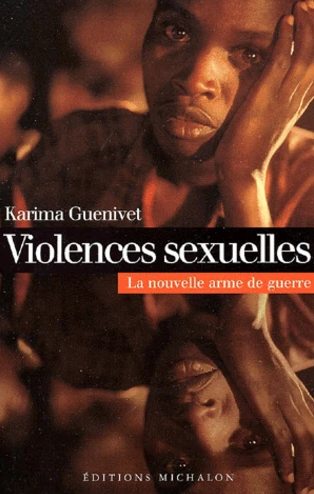
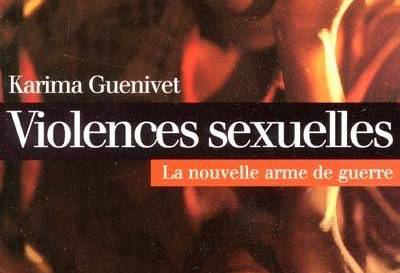
The couple’s awful conversation brings to mind the book “Violences sexuelles. La nouvelle arme de guerre” (Sexual violence. The new weapon of war), a powerful and important work written in 2002 by Karima Guenivet, a 31-year-old Franco-Algerian academic. As she herself writes, the aim of the book is to demonstrate, through recent historical cases (Bosnia, Rwanda, Algeria: as many scenarios as the documented exegesis explores), how sexual violence in war has always been a weapon that constitutes a crime against humanity, but at the same time, an instrument of offense and humiliation specific to the male gender against the female one.
Six years after the publication of her book, the United Nations officially declared wartime rape a specific war crime, a violation of universal human rights, recognized and sanctioned worldwide.
“Superiority has been given to people who kill, not to people who procreate”
“Sexual violence has been the subject of this tolerance devoted to fatalities for too long,” writes Guenivet. “When the book was published, some journalists repeated the same discourse to me. A discourse that ignores the facts and considers this crime as an inherent accessory to war, a “non-event”.”
A few figures: between 20,000 and 30,000 sexual rapes in Bosnia, from 1991 to 1992, rapes which the author defines as contributing to ethnic cleansing. In Rwanda, where violence was systematically accompanied the genocide. In the space of three months – from April to June 1994 – approximately one million women and children, mainly belonging to the Tutsi ethnic group, were massacred after having suffered sexual violence. Lastly, Algeria, where rape was used in the service of jihad, the default estimates of the country’s Health Ministry indicate more than 2,000 women raped by terrorist militias, who often chose their victims among women who refused to wear the veil or who were close to non-Islamist men.
Of the three countries, Algeria is the only one where the government has considered compensating the victims, or their families, in the event of the death of raped women.
“As the ‘host’ of the offspring of the enemy soldier, the author explains, the woman first becomes the object of rape, then of feminicide, thus confirming the rule that the best way to saving energy in time of war is to ensure that there will be no more enemies to face”. The shocking accounts of war.
It is necessary to achieve a better understanding of the context of silent or overt consent, and the underestimation of male violence against women as a constant practice, in times of peace as well as in times of war. There is no doubt that the increasing militarization of societies and communities, the assertion or reassertion of patriarchal power, either directly through war or indirectly through the development of supremacist and fundamentalist cultures, are responsible for rape as a war weapon. However, there is also the toxic storytelling passed down from generation to generation, because it is oblivious to the truth.
The history of humanity, in all parts of the world and at all times, tells us how male violence against women is structural and constitutive. We can observe this in the founding myths: in Italy, at school, we study the glorious story of the birth of Rome, and as from primary school we learn about the kidnapping of the Sabines. What is this about? It’s simple: in order to conquer the neighboring Sabina, the Romans organized a raid and deported women of childbearing age. We learned that it is a “kidnapping”, but in fact, it was a gang rape since no one asked the Sabines if they agreed. Nevertheless, do you think the word “rape” is mentioned in school textbooks? No, it never is.
It is necessary to achieve a better understanding of the context of silent or overt consent, and the underestimation of male violence against women as a constant practice, in times of peace as well as in times of war.

The challenge of the Women’s Tribunal was above all to demonstrate that there are subjects capable of resisting and opposing the scourge of the resurgence of nationalisms that want to divide the population according to ethnic and religious criteria, striving to make homogeneous nations by excluding minorities and diversity, separating and mortifying universal citizenship by building antagonistic “communities”.
The precious work of this model of feminist justice continues, and this is good news in the context of these terrible months of war in the heart of Europe. In the background, this feminist justice moves forward accompanied by the words of Simone de Beauvoir who wrote in The Second Sex: “Superiority has been given to people who kill, not to people who procreate”.